Full recording of the forum · 40 minutes · published on August 13, 2026 on AXONA’s YouTube channel (in Spanish). When played, the YouTube player loads in no-tracking-cookie mode.
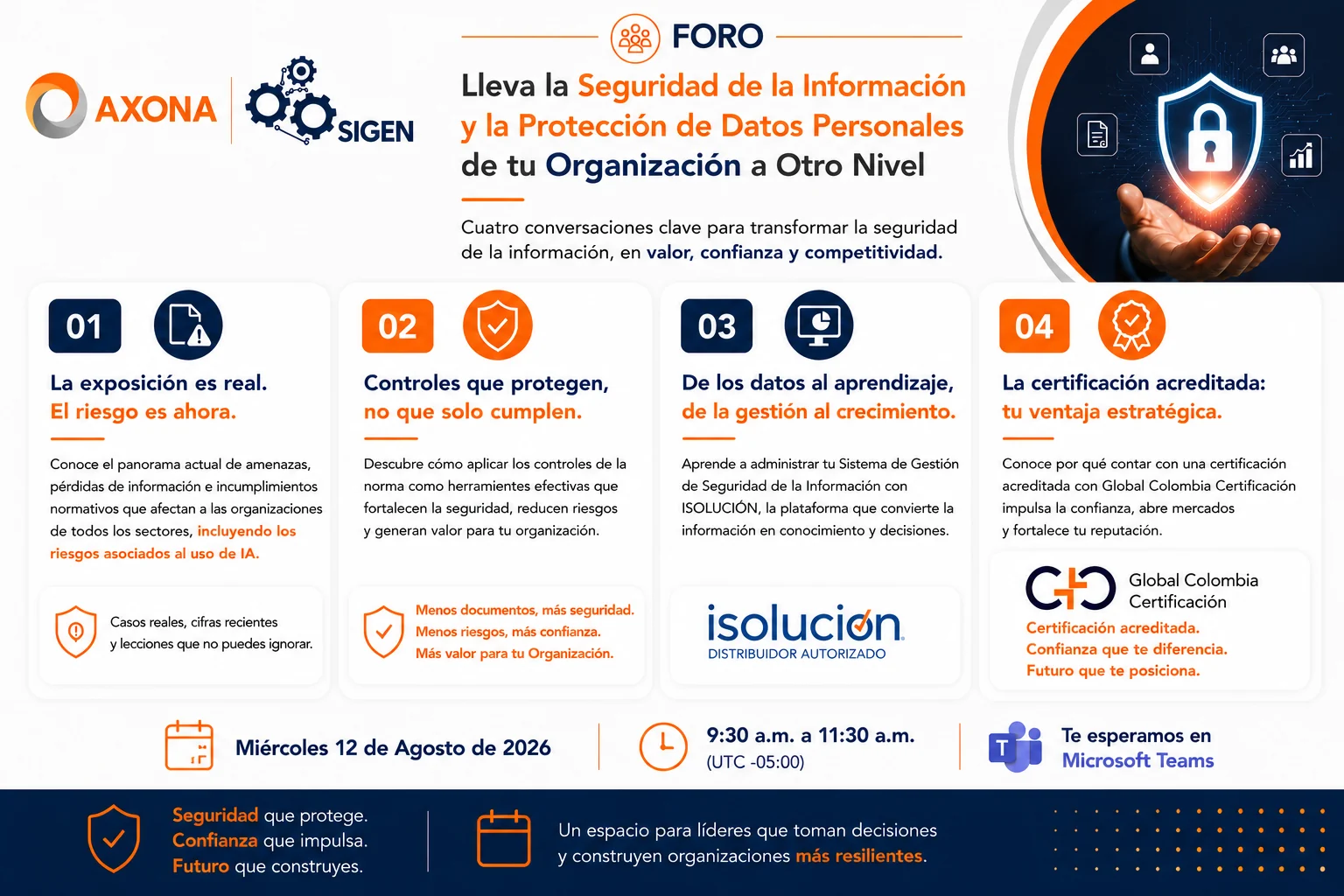
| Event | Forum “Take your Organization’s Information Security and Personal Data Protection to the Next Level” |
| Date and time | Wednesday, August 12, 2026, from 9:30 to 11:30 a.m. (UTC−05:00) |
| Format | In-person panel in Bogotá, attendees connected via Microsoft Teams |
| Program | Four conversations: risk exposure · controls that protect · management with ISOLUCIÓN · accredited certification |
| Recording | 40 minutes and 20 seconds, published on August 13, 2026 |
| Regulation in force in Colombia | Statutory Law 1581 of 2012 and Decree 1074 of 2015 |
| International standards | ISO/IEC 27001:2022 and ISO/IEC 27701:2025 |
| Maximum sanction | 2,000 monthly minimum wages — COP 3,501,810,000 with the 2026 minimum wage |
Who was on the panel
The forum brought together profiles that rarely sit at the same table: the one who sells the tool, the one who audits and certifies, the one who advises the public sector and the one who runs day-to-day security. The format was deliberate —the panelists talked in person in Bogotá while attendees took part remotely— so that the conversation would be among peers and not a series of presentations.
- Martha Elena DelgadoCommercial Director, ISOLUCION
- Raúl EcheverryTechnical Director, Global Colombia Certificación
- Gina Paola PeñaGovernance, Risk and Compliance Advisor
- Rosa María GonzálesGovernment Sector Advisor in Institutional Management
- Orlando LemaitreIT Lead for Cybersecurity, Information Security and Data Protection
Moderation and organization were in the hands of AXONA, through its SIGEN service line, and the session closed with a satisfaction and needs-identification survey among attendees.
The forum’s four conversations
The program was built around four conversations, designed to cover the whole path —from risk to competitive advantage— in two hours:
01 · The exposure is real. The risk is now.
The current landscape of threats, information loss and regulatory non-compliance affecting organizations in every sector, including the risks associated with the use of artificial intelligence. Real cases, recent figures and concrete lessons.
02 · Controls that protect, not just comply.
How to apply the standard’s controls as effective tools that strengthen security and reduce risk, rather than as a documentary layer produced for the audit that changes nothing in operations.
Fewer documents, more security. Fewer risks, more trust.
03 · From data to learning, from management to growth.
Managing the Information Security Management System with ISOLUCIÓN, the platform that turns system information into knowledge and decisions. AXONA is an authorized distributor.
04 · Accredited certification: your strategic advantage.
Why a certification issued by an accredited body —in this case Global Colombia Certificación— drives trust, opens markets and strengthens reputation, and how it differs from a certificate without accreditation backing.
What has not changed: Law 1581 of 2012 is still the law
It is the most widespread confusion in conversations about data protection in Colombia. There has been so much talk about the reform that many organizations assume there is already a new regime, or that it is better to wait for it before starting. There is no new regime. As of the publication of this article, the regulation in force is still Statutory Law 1581 of 2012, regulated by Decree 1074 of 2015.
The congressional record explains why. Three bills have tried to replace it and none became law:
- Bill 156 of 2023 (House) — “Issuing provisions for the General Personal Data Protection Regime”. Filed on August 22, 2023 and withdrawn on May 8, 2024, under Article 155 of Law 5 of 1992.
- Bill 152 of 2024 (House) — same title, filed on August 6, 2024 and shelved on June 24, 2025, under Article 190 of Law 5 of 1992.
- Statutory Bill 274 of 2025 (House) — “Partially amending Law 1581 of 2012 and issuing other provisions on the fundamental right to personal data protection”. It is the one filed by the Government on August 27, 2025 through the Ministry of Commerce, Industry and Tourism and the Ministry of Science, Technology and Innovation. It had a public hearing on September 25, 2025, passed its first debate in the First Permanent Constitutional Committee according to Minutes 18 of October 28, 2025, was merged with Bill 214 of 2025 (House), and is now listed as shelved in the House of Representatives’ record.
What that bill proposed is still the best map of where regulation is heading: the right to erasure, portability, protection against automated decisions without human review, a ban on profiling and targeted advertising aimed at minors under 18, mandatory incident notification, impact assessments, the appointment of a data protection officer in certain cases, and an authority with reinforced independence within the Superintendence of Industry and Commerce. None of that is mandatory today. All of it is worth anticipating, because the direction of change is clear and because almost all of it rests on practices that a mature management system already has.
What has changed: ISO/IEC 27701 is no longer an annex
The relevant move of the past year came not from Congress but from ISO. The 2019 version of ISO/IEC 27701 was an extension: it could not be certified on its own; you first had to have an information security management system under ISO/IEC 27001 and add the privacy requirements on top.
On October 14, 2025, ISO/IEC 27701:2025 was published, “Information security, cybersecurity and privacy protection — Privacy information management systems — Requirements and guidance”, now as a standalone management system standard. Privacy becomes a certifiable system in its own right, with its own structure of requirements, which can be integrated with the ISMS or maintained separately.
For a Colombian organization, the practical effect is concrete: the way to show a client, a partner or a regulator that personal data protection is managed no longer depends on first having an ISO/IEC 27001 certificate. The transition rules for those certified under the 2019 edition are still being defined by the IAF, so there is no urgency for current certificates; but any implementation starting today should do so directly on the 2025 edition.
The obligations most frequently breached today
These are the four that appear again and again in diagnoses, and none of them depends on the reform:
- National Database Registry (RNBD). Companies and non-profit entities with total assets above 100,000 UVT must register —which, with the 2026 UVT set at COP 52,374 by DIAN Resolution 000238 of December 15, 2025, equals COP 5,237,400,000— as well as all public-law legal entities, with no threshold. Databases created after the initial deadline must be registered within two months of their creation.
- Processing policy and privacy notice. It is not enough for them to exist and be published: they must describe what the organization actually does with the data. Inconsistency between the published policy and actual operations is the most common finding.
- Prior, express and informed authorization, and respect for the purpose. Using data for a purpose other than the one authorized is an independent infringement, even if the original authorization is impeccable.
- Deadlines for inquiries and claims. Inquiries are answered within a maximum of ten business days, extendable by five. Claims, within fifteen business days, extendable by eight. Without a procedure assigned to a specific person, those deadlines expire on their own.
What non-compliance costs
Article 23 of Law 1581 of 2012 empowers the Superintendence of Industry and Commerce to impose on data controllers and processors:
- Personal and institutional fines of up to 2,000 current legal monthly minimum wages at the time the sanction is imposed. With the 2026 minimum wage —COP 1,750,905, set by Decrees 1469 and 1470 of December 29, 2025— the ceiling is COP 3,501,810,000.
- Suspension of the activities related to the processing for up to six months.
- Temporary closure of operations when, once the suspension has expired, the causes have not been corrected.
- Immediate and permanent closure of the operation involving the processing of sensitive data.
The fine is personal and institutional. That word usually goes unnoticed, and it is the one that changes the conversation in a management committee.
Where the management system fits in
The question running through the whole forum is why an organization should set up a management system if the law does not expressly require it. The answer is that the law does require the result —demonstrating diligence, traceability and control— and the management system is the only orderly way to produce that evidence before someone asks for it.
ISO/IEC 27001:2022 reorganized Annex A into 93 controls grouped into four themes —organizational, people, physical and technological— and introduced eleven new controls, including threat intelligence, information security for cloud services and data masking. Several of those controls are, literally, the ones the Superintendence asks to see when it investigates an incident.
ISO/IEC 27701:2025 adds on top the vocabulary that Colombian law already uses —data controller and data processor— and turns consent, purpose, minimization, retention and handling of data subjects’ rights into auditable requirements. An integrated ISO/IEC 27001 + ISO/IEC 27701 system covers, in a single body of documentation, what Law 1581 requires today and much of what the reform will propose when it returns to Congress.
What to do in the next 90 days
- Database inventory. Which databases exist, who is responsible for each, what data they contain, for what purpose and for how long. Without this, nothing else can be done.
- Check the RNBD threshold. Review total assets at the last year-end against the 100,000 UVT and, if applicable, register or update the report.
- Compare the published policy with actual operations and correct whichever is out of line, which is almost always the policy.
- Review authorizations: that they exist, that they can be proven and that the stated purpose covers the current use of the data.
- Assign by name the handling of inquiries and claims, with deadlines and a record of responses.
- Decide the scope of the management system: whether you protect information in general (ISO/IEC 27001), personal data (ISO/IEC 27701) or both in an integrated system.
Frequently asked questions
Has Colombia’s personal data protection law already changed?
No. As of this article, the regulation in force is still Statutory Law 1581 of 2012, regulated by Decree 1074 of 2015. Bills 156 of 2023 (House), 152 of 2024 (House) and 274 of 2025 (House) were withdrawn or shelved, the latter after being merged with Bill 214 of 2025 (House).
What changed in ISO/IEC 27701, and since when?
On October 14, 2025, ISO/IEC 27701:2025 was published, turning the standard into a standalone privacy management system. Up to the 2019 edition it was an extension of ISO/IEC 27001 and ISO/IEC 27002 and could not be certified separately. The transition rules for current certificates are being defined by the IAF.
Must my company register in the National Database Registry?
It must register if it is a company or non-profit entity with total assets above 100,000 UVT —COP 5,237,400,000 with the 2026 UVT, set at COP 52,374— or if it is a public-law legal entity, in which case there is no threshold. Databases created after the initial deadline are registered within two months of their creation.
What is the maximum sanction for breaching Law 1581 of 2012?
Article 23 allows personal and institutional fines of up to 2,000 current legal monthly minimum wages, equivalent to COP 3,501,810,000 with the 2026 minimum wage of COP 1,750,905. It also provides for suspension of activities for up to six months, temporary closure, and immediate and permanent closure in the case of sensitive data.
Do I need ISO/IEC 27001 certification to comply with Colombian law?
No. Law 1581 of 2012 does not require certification. It requires a result: demonstrating diligence, traceability and control over the processing. A certified management system is the most orderly way to produce that evidence and sustain it over time, but it is not a legal requirement.
Where can I watch the full recording of the forum?
The full recording, 40 minutes and 20 seconds long, is published on AXONA’s YouTube channel and embedded at the top of this article (in Spanish). It was published on August 13, 2026.
Primary sources
- Statutory Law 1581 of 2012 — official text (Senate Secretariat, in Spanish)
- Superintendence of Industry and Commerce — National Database Registry (in Spanish)
- House of Representatives — Statutory Bill 274 of 2025 and its status (in Spanish)
- ISO/IEC 27001 — Information security management systems
- ISO/IEC 27701:2025 — Privacy information management systems
Need support on this topic? We offer an initial scope assessment at no cost.
Let’s talk about your case →About the author
ONAC Lead Evaluator since 2012 and ISO Management Systems Lead Auditor since 2005 at accredited certification bodies. Industrial Engineer, Master in Organizational Management and Specialist in Occupational Health and Safety. Graduate professor in specialization and master’s programs at Colombian universities. More than 25 years of experience in manufacturing and services, in the public and private sectors.
View professional profile on LinkedIn →